Posts

Showing posts with the label a11y

Release of new version of GNU/Linux distribution for Cognitively Challenged by CDAC, Mumbai

Centre for Development of Advanced Computing (CDAC) has released the new version (version 0.1.2) of GNU/Linux distribution for CognitivelyChallenged . Cognitively challenged people face different kinds of problems such as memory loss, forgetfulness, attention problems etc. Therefore, the major objective of this distribution is to provide an accessible desktop environment suitable to such users. The major highlights of this distribution are simplified and accessible desktop environment, simplified applications, tagged file system, tag-based searching, user’s activity log, reminder facility etc. that are specifically aimed to reduce distraction and memory load during computer interaction. These salient features of the distribution can be of immense help to such users and their caretakers, while using computer. This distribution is based on Ubuntu 10.04 and offers a number of improvements/enhancements over previously released version (version 0.1.1). These improvements/enha...

ALViC - Accessible Linux for Visually Challenged launched

ALViC- Accessible Linux for Visually Challenged was launched on 11th February, 2013 by Prof R. Chidambaram, Principal Scientific Adviser, Govt. of India & Shri J. Satyanarayana, Secretary, DeitY, Ministry of Comm. & I.T., Govt. of India during the CDAC Technology Conclave on 11th Feb, 2013 at Indian Habitat Centre, New Delhi. During the 2-days technology conclave, a number of technologies and products developed by CDAC under various thematic area were showcased. ALViC is a complete desktop environment which provides a comprehensive solution for Visually Challenged users. This is a GNU/Linux distribution based on Ubuntu 10.04; and uses Orca 3.2.0 xdesktop screen reader as the main interaction mechanism for visually challenged users. They can use it out of the box because accessibility features suitable for fully blind as well as for partially blind users are enabled by default. Main Features : Free and open source desktop environment Enhanced Orca with ski...

New version of Anumaan - open source predictive text entry system from CDAC, Mumbai released

CDAC, Mumbai has announced the new release of open source predictive text entry system - Anumaan . This release includes new version of standalone flavour of Anumaan i.e. Anumaan-standalone-0.2. This version has been released as part of the activities of project "Enhancing Accessibility for FOSS Desktops" under NRCFOSS-Phase II being carried out at CDAC, Mumbai. Anumaan gives predictions based on preceding text/words used by the user in his/her text and user can use these predictions, while composing text. By incorporating predictions, user can improve his/her rate of text entry to a great extent. Anumaan is mainly intended to help persons with motor disabilities, specially ones facing problems in hand and finger movement. Such persons face difficulty in using regular input devices like keyboard for text entry related tasks. Anumaan can help such persons immensely in their text entry related tasks by way of predictions. However, It is equally useful for com...

Computer Training Program for Visually Challenged at CDAC, Kharghar, Navi Mumbai during July 23–August 4, 2012

Image
About training In India, about 7-8 million people are suffering from full or partial visual impairment. Such people have to be provided with different kinds of support devices to access the world and to perform routine tasks like bill payments, banking transactions, reservations etc.. Now technology, either software-based or hardware-based, has made it possible for these people to access the world in their own way. But a large section of blind population is still away from advantages of modern assistive technologies. The main reasons for this gap are not only the lack of awareness about assistive technologies available and lack of hands-on practice to use it, but also the cost of technology. Free & Open Source Software (FOSS) tools/techniques play an important role in creating assistive technologies that are free-of-cost, available to all and easily maintainable for a large portion of population in a country like India. For visually challenged people, available co...

GEM (GEstures with Mouse) – a mouse gesture based input mechanism from CDAC, Mumbai

Image
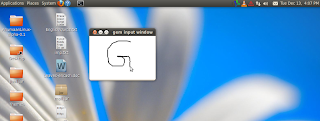
CDAC, Mumbai has released beta-0.1 version of GEM (GEstures with Mouse). It is an open source input mechanism which uses gestures as input to the system. Gestures can be drawn using a mouse or some equivalent device like touch pad, joystick, pen tablet etc. Gestures can drawn either as single-part (continuous) or multi-part (discontinuous) as shown in screen shots below: Drawing a single-part gesture in input window Drawing a multi-part gesture in input window This Input mechanism is intended for people suffering with different kinds of motor disabilities, who may face problems in using mouse and keyboard in conventional way. Hence, it provides them with an alternate and effective mechanism for using the system to perform various tasks such as navigation, executing commands & keyboard shortcuts, and launching applications etc. on Linux desktop. More details about GEM can be accessed at http://www.cdacmumbai.in/accessibility . GEM related URLs: 1...