Posts

Showing posts with the label CDAC Mumbai

2019 series of data science courses from CDAC, Mumbai announced

Image
Registrations are open for 2019 series of short-term courses on Data Science from CDAC,  Mumbai . For more details and registrations, visit at http://kbcs.in/datascience  . Schedule of Data Science courses from CDAC, Mumbai

Text Analytics – Getting insights from text

Image
Technology revolution is changing every aspect of the human life. Media and Marketing are no different. Among all the technologies that are contributing to the advancement, Data Science is at the forefront. As Text Data is being continuously generated and consumed in various formats and sizes from a number of varied sources, it is becoming an important asset to organizations. But this asset can be leveraged upon, only if stored, processed and analysed efficiently with the help of intelligent algorithms. There is a growing interest to utilize such data for the improvement of business, health, education, society, etc. There are many ways to process and analyse such data, covering broad techniques such as text visualisation, classification, named entity recognition, sentiment analysis, etc. Effective applications of these techniques can give organisations valuable insights leading to competitive advantage, efficient service delivery and above all higher customer satisfact...

Data Science Courses 2017 from CDAC, Mumbai

Image
Next series of Short-term courses on Data Science from CDAC Mumbai announced. Registration Open - http:// kbcs.in/datascience/  

R – your tool for data analysis

R‬ is a language and environment for Statistical Computing and Graphics. R provides a free/open source, cross­-platform, object-oriented environment to perform data analysis and visualisation tasks. Strength of R lies in its vibrant community, robust package repository and strong graphics capabilities. ‪ R provides all necessary tools required for various stages of a data analysis project. It provides techniques for data acquisition and processing as well as for data analysis and visualisation. It ranges from accessing data in various formats (CSV, XML…) to all possible ways of data manipulation (tabulation, aggregation…)to rich support for graphics (histogram, box plot etc.) to statistical models (regression, ANOVA…). It is not always necessary to use built-in and supported functions and packages. Depending on the requirements, one can also develop his/her own functions, scripts and packages. Recently, CDAC Mumbai has announced a 3-day course on R entitled “Using R...

ICT for School workshop at CDAC, Kharghar, Navi Mumbai on November 20, 2015

Image
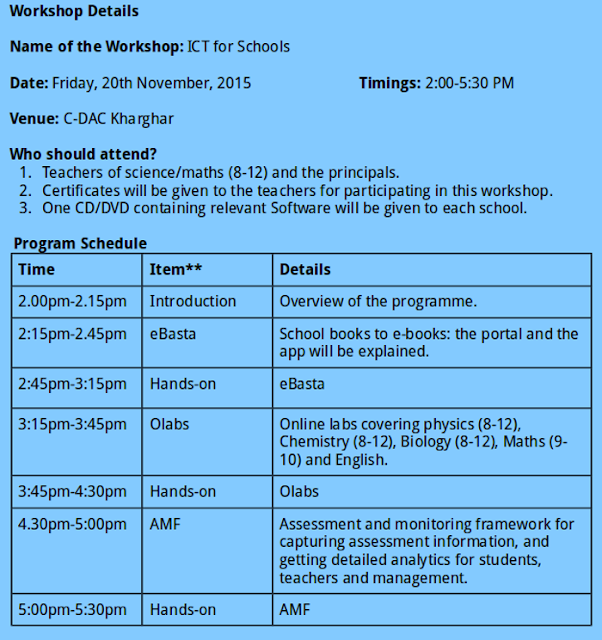
A half day Workshop on “ICT for Schools” will be conducted on Friday 20th November, 2015 [2:00 PM-5:30 PM] at Kharghar campus of C-DAC Mumbai. The workshop will be covering presentation-cum-demo on: Online Labs eBasta - School Books to eBooks and Assessment and Monitoring Framework. CBSE/STATE board teachers from Classes VIII, IX, X ; Subjects - Science, Maths, English are invited to participate in this workshop. This workshop will be conducted by Educational Technology Unit of C-DAC Mumbai.  Please comment or write to etu[AT]cdac[DOT]in, if you are interested, or want more information.

Workshop on “ICT for Schools” on Friday 16th October, 2015 at Kharghar campus of C-DAC Mumbai

Image
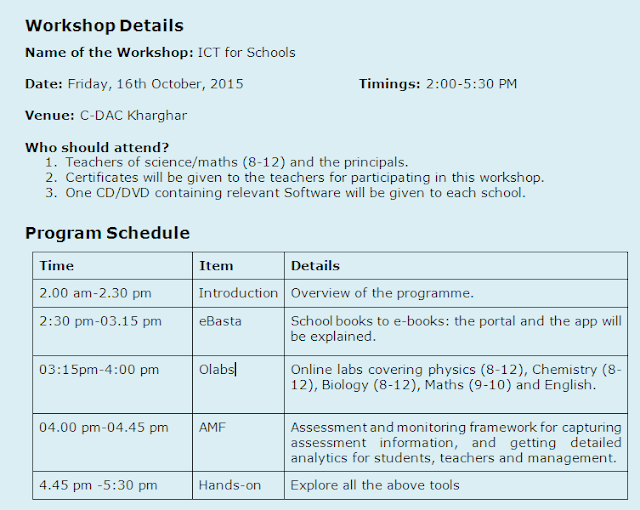
A half day Workshop on “ICT for Schools” will be conducted on Friday 16th October, 2015 [ 2:00 PM - 5:30 PM ]  at Kharghar campus of C-DAC Mumbai . The workshop will be covering presentation-cum-demo on 1) Online Labs 2) eBasta - School Books to eBooks and 3) Assessment and Monitoring Framework. CBSE/Stateboard teachers from Classes VIII, IX, X ; Subjects - Science, Maths, English are invited to participate in this workshop. This workshop will be conducted by Educational Technology Unit of C-DAC Mumbai. Attached document contains more information about the workshop.  Please write to etu@cdac.in for registration and other details.  

Open House at CDAC on the occasion of National Science Day

Image
CDAC Mumbai is organising an Open House on the occasion of National Science Day(28th February, 2014) at its Kharghar, Navi Mumbai campus. This Open House will not only showcase CDAC products and projects, but also include Quiz Show, Programming Competition and Much More.

Sangrah – Knowledge Repository for FOSS in Education from CDAC, Mumbai

CDAC, Mumbai has announced the beta release of portal Sangrah – Knowledge Repository for FOSS in Education . This portal contains resources about different categories like Learning Management System, Content Management System, etc. It also contains user experiences for these categories, comparative analysis of various tools from these categories, specialised search, and collaboration facility for community supported content updates. The portal is maintained with least manual intervention as most of the tasks including, resource collection, categorization, user experience identification, comparative analysis, etc are largely automated. The portal is intended for academic institutions, entrepreneurs, among others to help them to adopt Free and Open Source Softwares (FOSS). The portal is still evolving, hence feedback about the portal, improvement suggestions can be given through the feedback section on portal. Users can visit and register on the portal at -  htt...

One year full-time PG-DST course from CDAC

C-DAC Mumbai is offering 1-year full-time Post Graduate Diploma in Software Technology (PG-DST) for the past several years with excellent placement records. The course provides a systematic blend of theory and hands-on, foundational and advanced concepts, and includes current trends and technologies.   Admission is now open for the next batch of PG-DST commencing on 27th August 2013, and its admission test (CST) will be held on 14th July 2013. Application form and more details of the course are given in brochure: PGDST_Brochure .  The PG-DST course exposes the candidates to a variety of tools and frameworks including programming languages (C, C++ and Java), database systems (MySQL, Oracle, Hibernate, NoSQL), development frameworks (Spring, HTML-5, PHP, JavaScript), tools in software engineering (Redmine, Git), Operating systems (Gnu/Linux, Windows, Android), etc.    Contact details:   C-DAC, Near Kharghar Rly Stn, Navi Mumbai (Tel 022-27565...

Release of new version of GNU/Linux distribution for Cognitively Challenged by CDAC, Mumbai

Centre for Development of Advanced Computing (CDAC) has released the new version (version 0.1.2) of GNU/Linux distribution for CognitivelyChallenged . Cognitively challenged people face different kinds of problems such as memory loss, forgetfulness, attention problems etc. Therefore, the major objective of this distribution is to provide an accessible desktop environment suitable to such users. The major highlights of this distribution are simplified and accessible desktop environment, simplified applications, tagged file system, tag-based searching, user’s activity log, reminder facility etc. that are specifically aimed to reduce distraction and memory load during computer interaction. These salient features of the distribution can be of immense help to such users and their caretakers, while using computer. This distribution is based on Ubuntu 10.04 and offers a number of improvements/enhancements over previously released version (version 0.1.1). These improvements/enha...

One-day workshop on Parikshak — an online program grading system organised by CDAC, Mumbai

Computer Programming is an important aspect of any computer-science/information-technology course. This is among the most difficult to teach, since being a good programmer is a skill to be acquired coupled with knowledge of many different aspects such as abstraction, analysis, structured programming, debugging, etc. Usually computer programming is taught through a combination of theory classes on concepts and languages, and lab classes on specific languages. Assignments are given, which are manually graded by the instructor. Manual grading of programs is very tedious and time consuming. While evaluating student assignments the teacher has to act as a compiler/interpreter and inspect each line in program and judge whether the overall program would work correctly. While this grading approach works fine for a small number of simple assignments, it gets unwieldy as the complexity and number of the assignment increases. This, in turn, results in inadequate attention to the practical progra...

ALViC - Accessible Linux for Visually Challenged launched

ALViC- Accessible Linux for Visually Challenged was launched on 11th February, 2013 by Prof R. Chidambaram, Principal Scientific Adviser, Govt. of India & Shri J. Satyanarayana, Secretary, DeitY, Ministry of Comm. & I.T., Govt. of India during the CDAC Technology Conclave on 11th Feb, 2013 at Indian Habitat Centre, New Delhi. During the 2-days technology conclave, a number of technologies and products developed by CDAC under various thematic area were showcased. ALViC is a complete desktop environment which provides a comprehensive solution for Visually Challenged users. This is a GNU/Linux distribution based on Ubuntu 10.04; and uses Orca 3.2.0 xdesktop screen reader as the main interaction mechanism for visually challenged users. They can use it out of the box because accessibility features suitable for fully blind as well as for partially blind users are enabled by default. Main Features : Free and open source desktop environment Enhanced Orca with ski...

Anumaan listed on Softpedia

Anumaan – open source predictive text entry system from CDAC, Mumbai has been added to the database of Softpedia . Softpedia is a library of over 400,000 free and free-to-try softwares. Anumaan on Softpedia can be accessed from here . Anumaan has also been awarded “100% Free” award from Softpedia signifying that Anumaan is a clean product. Anumaan home page

RPM package of GEM (GEstures with Mouse) released

RPM package of GEM (GEstures with Mouse) has been released. GEM (GEstures with Mouse) is a mouse-gesture based input mechanism developed by CDAC, Mumbai for people with motor disabilities. It can be downloaded now from http://sourceforge.net/projects/gem-cdac/files/gem-0.1-1.i686.rpm/download or from http://www.cdacmumbai.in/accessibility.

New version of Anumaan - open source predictive text entry system from CDAC, Mumbai released

CDAC, Mumbai has announced the new release of open source predictive text entry system - Anumaan . This release includes new version of standalone flavour of Anumaan i.e. Anumaan-standalone-0.2. This version has been released as part of the activities of project "Enhancing Accessibility for FOSS Desktops" under NRCFOSS-Phase II being carried out at CDAC, Mumbai. Anumaan gives predictions based on preceding text/words used by the user in his/her text and user can use these predictions, while composing text. By incorporating predictions, user can improve his/her rate of text entry to a great extent. Anumaan is mainly intended to help persons with motor disabilities, specially ones facing problems in hand and finger movement. Such persons face difficulty in using regular input devices like keyboard for text entry related tasks. Anumaan can help such persons immensely in their text entry related tasks by way of predictions. However, It is equally useful for com...

Computer Training Program for Visually Challenged at CDAC, Kharghar, Navi Mumbai during July 23–August 4, 2012

Image
About training In India, about 7-8 million people are suffering from full or partial visual impairment. Such people have to be provided with different kinds of support devices to access the world and to perform routine tasks like bill payments, banking transactions, reservations etc.. Now technology, either software-based or hardware-based, has made it possible for these people to access the world in their own way. But a large section of blind population is still away from advantages of modern assistive technologies. The main reasons for this gap are not only the lack of awareness about assistive technologies available and lack of hands-on practice to use it, but also the cost of technology. Free & Open Source Software (FOSS) tools/techniques play an important role in creating assistive technologies that are free-of-cost, available to all and easily maintainable for a large portion of population in a country like India. For visually challenged people, available co...

GNU/Linux distributions for Differently-abled people from CDAC, Mumbai

Centre for Development of Advanced Computing (CDAC), Mumbai has released beta versions of GNU/Linux distributions for Differently-abled people. These distributions are part of the activities being carried out under “ Enhancing Accessibility for FOSS Desktops ” project under NRCFOSS-Phase II at CDAC, Mumbai . There are three distributions specific to three different kinds of disabilities namely: 1. GNU/Linux distribution for Visually-challenged: This is a GNU/Linux distribution (beta version – 0.1.1) created specially for visually challenged users. Visually challenged users can use it out of the box because accessibility settings required by them are already enabled. 2. GNU/Linux distribution for Physically-challenged: ‘ GNU/Linux for Physically Challenged-Beta-0.1.1′ is a special distribution for physically challenged people, so that they can easily access FOSS desktops. 3. GNU/Linux distribution for Cognitively-challenged: This GNU/Linux distribution has...

GEM (GEstures with Mouse) – a mouse gesture based input mechanism from CDAC, Mumbai

Image
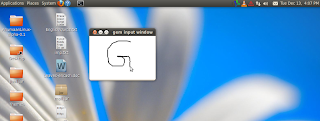
CDAC, Mumbai has released beta-0.1 version of GEM (GEstures with Mouse). It is an open source input mechanism which uses gestures as input to the system. Gestures can be drawn using a mouse or some equivalent device like touch pad, joystick, pen tablet etc. Gestures can drawn either as single-part (continuous) or multi-part (discontinuous) as shown in screen shots below: Drawing a single-part gesture in input window Drawing a multi-part gesture in input window This Input mechanism is intended for people suffering with different kinds of motor disabilities, who may face problems in using mouse and keyboard in conventional way. Hence, it provides them with an alternate and effective mechanism for using the system to perform various tasks such as navigation, executing commands & keyboard shortcuts, and launching applications etc. on Linux desktop. More details about GEM can be accessed at http://www.cdacmumbai.in/accessibility . GEM related URLs: 1...

National Workshop on Adaptive Instruction at CDAC, Kharghar, Navi Mumbai during December 15-16, 2011

This workshop will explore the current trends in the field of personalization in the context of e-learning, particularly in instruction delivery. As we all are aware, e-learning has been around for quite a long time now. It is widely accepted by both the industry and the academics as a convenient medium for providing learning environment to the employees/students. E-learning can be made more effective by personalizing the instruction and adapting it to suit the individual learner. The workshop addresses issues and challenges in adaptive instruction and highlights the emerging trends in adaptive instruction. The participants will also get to experience the work of C-DAC Mumbai in creating and using adaptive instruction in education with Anurup . The workshop will also provide an opportunity to interact with participants from different organizations and industry practitioners interested in the emerging area. This workshop is being organized by CDAC, Mumbai at their Kharg...

National Workshop on FOSS Desktop Accessibility on August 26, 2011 at CDAC, Kharghar, Navi Mumbai

In today’s world, the use of information and communication technologies (ICT) is growing day by day. We use these technologies very extensively in fulfilling our routine tasks like bill payments, banking transactions, reservations and many more to the extent that ICT is not a luxury, but necessity today. A large section of the society comprising people with disabilities finds it difficult to use ICT in the same way as normal people do. This includes the visually impaired (fully or partially blind), hearing impaired, people with cognitive disabilities (memory loss, etc.) and cerebral problems etc.. Such people have to be provided with different kinds of assistive technologies either software-based or hardware-based to make ICT accessible to them. A large number of software-based assistive technologies are normally in the form of applications running on desktops which make common desktop applications (office applications, browser etc.) accessible for the disabled person. Fr...